Home
Home  Find music information
  Ventures
  Our patronages
  POLMIC network of websites





The opera project dedicated to Poland’s capital was developed over the course of four years, during which its concept evolved—from a work focused on the uplifting narrative of Warsaw’s rebirth to an opera depicting the difficult and painful process of rebuilding the city. By portraying the tragedy of survivors and the hardships faced by Varsovians as they raised their city from the ruins, the opera avoids being surreal or detached.
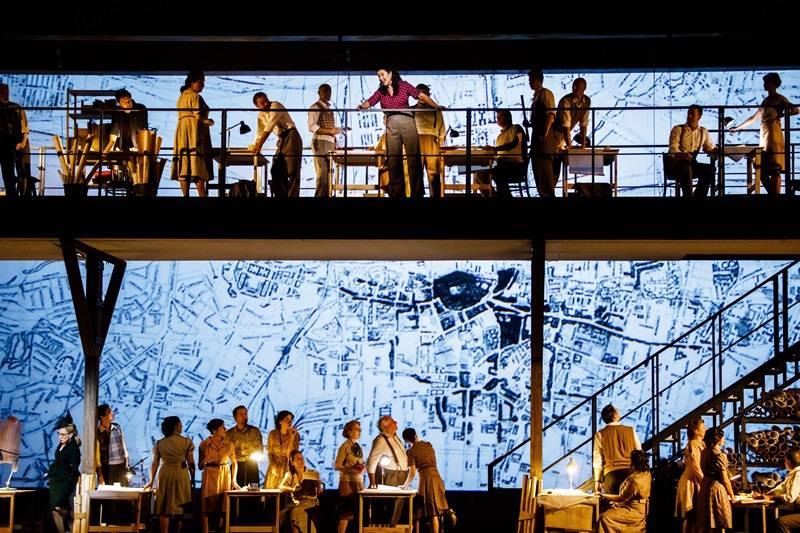
Cezary Duchnowski’s first grand opera reflects a panorama of the early postwar years and incorporates real events uncovered by Grzegorz Piątek in his book The Best City in the World. Warsaw Rebuilt 1944–1949.
The world premiere of Opera about Warsaw, with music by Cezary Duchnowski and a libretto by Beniamin M. Bukowski, marked the beginning of the exceptional jubilee season “1825–1965–2025” at the Teatr Wielki – Polish National Opera, as well as the 68th Warsaw Autumn International Festival of Contemporary Music.
Founded in 1956, the Festival was for many years the only event of its kind in the countries of the Eastern Bloc. Its founding ideas were to resist the prevailing ideology of socialist realism, promote creative freedom, and connect with new artistic trends.
The theme of the 68th edition is “Clearance” (Prześwit). As Festival Director Jerzy Kornowicz notes in the introduction to the festival’s program book, this “keyword of this year’s edition is a symbol of a new stage, an opening, and a chance—both socially and personally. It expresses a hope for the future in unstable times. We focus on art that doesn’t share its alarming intuitions to overwhelm us, but rather to warn, protect, and guide us back to normalcy.”
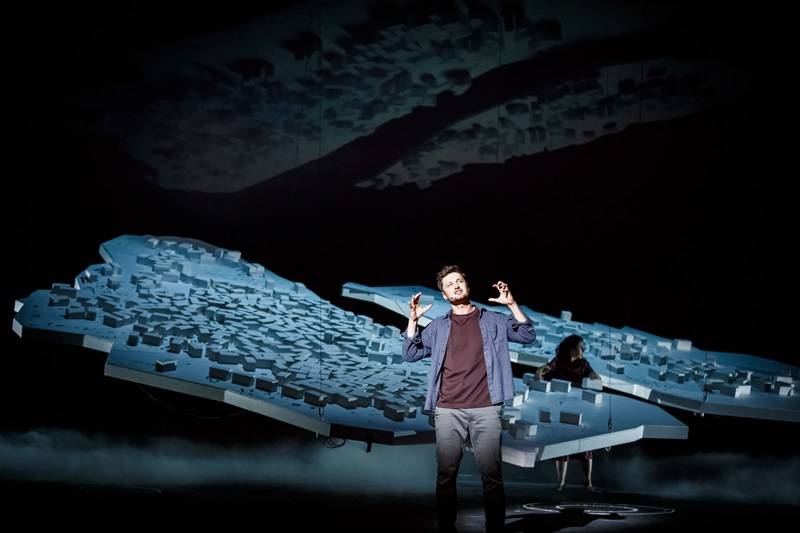
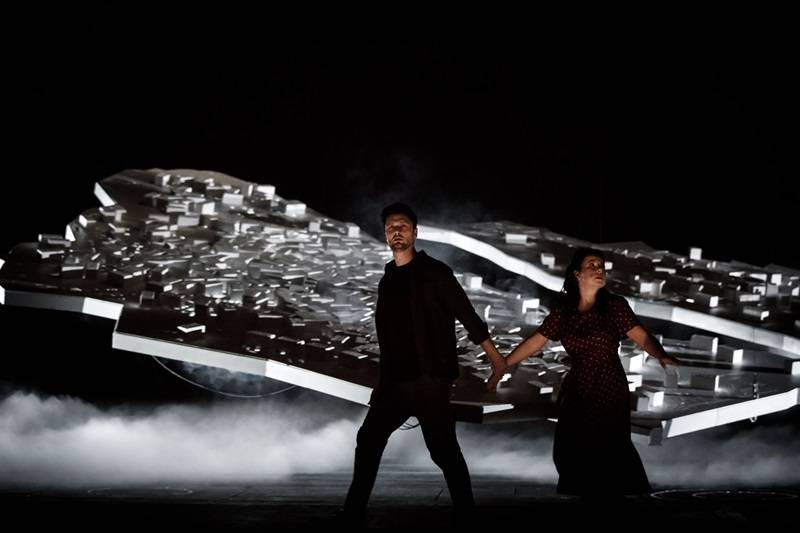
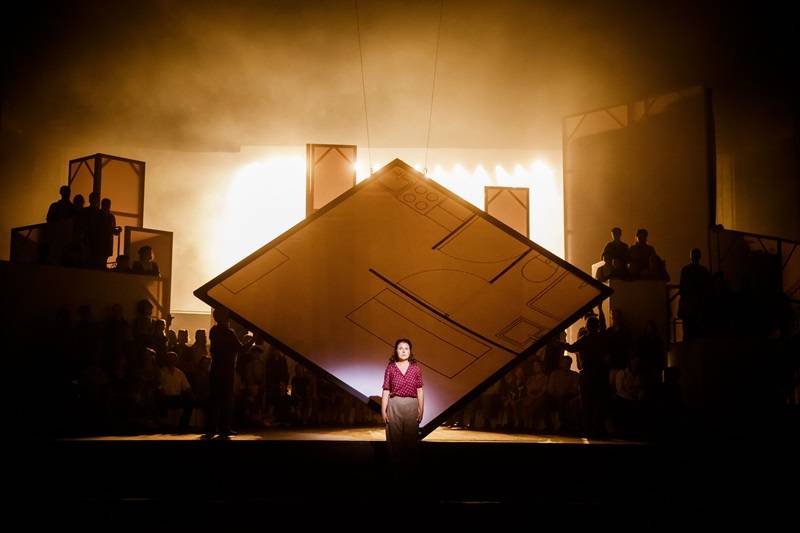
All around the world, the saying that history should help us learn from past mistakes is often repeated—yet people keep undermining the pursuit of normal life. In his libretto, Beniamin Bukowski references the names of beautiful cities destroyed already in the 21st century. He and the composer frequently repeat certain fragments. This technique of shaping the dramaturgy of scenes—developed by director Barbara Wiśniewska in collaboration with dramaturg Marcin Cecko—is especially striking and emphasized in the set design by Natalia Kitamikado.
The creators urge the audience to listen not only to the lessons of history but also to the multilayered meaning of the text performed by the musicians.
A better cast for this polymedial work could hardly be imagined—the performers are exceptional interpreters of contemporary music, and many have been invited to participate in past editions of Warsaw Autumn.
In keeping with operatic tradition, both main female characters have their own leitmotifs, which are gradually transformed by the composer. The encounter between the architect (Agata Zubel), working at the Bureau for the Reconstruction of the Capital, and the reporter (Joanna Freszel), an idealistic communist traveling across a war-torn Poland with the Red Army, forces both women to reconsider their worldviews. Zubel’s part features cantabile motifs enhanced with the “elettrovoce” effect, symbolizing dreams of rebuilding the city. The sarcastic American journalist’s part includes laugh motifs, which disappear entirely in Act II. In their farewell scene, the characters sing nearly identical melodies with lamento-like intonation—both now aware of the horrors of communist reality.
The composer made a deliberate choice not to include any musical quotations from well-known songs about Warsaw. However, he consciously references the aesthetics of socialist realism—especially its simplistic mass songs meant to force people into repeating false communist slogans. In the libretto itself, the rebuilding of Warsaw is initially compared to a musical score or creative improvisation, only to be crushed later by the monotonous propaganda of the socialist-realist era.
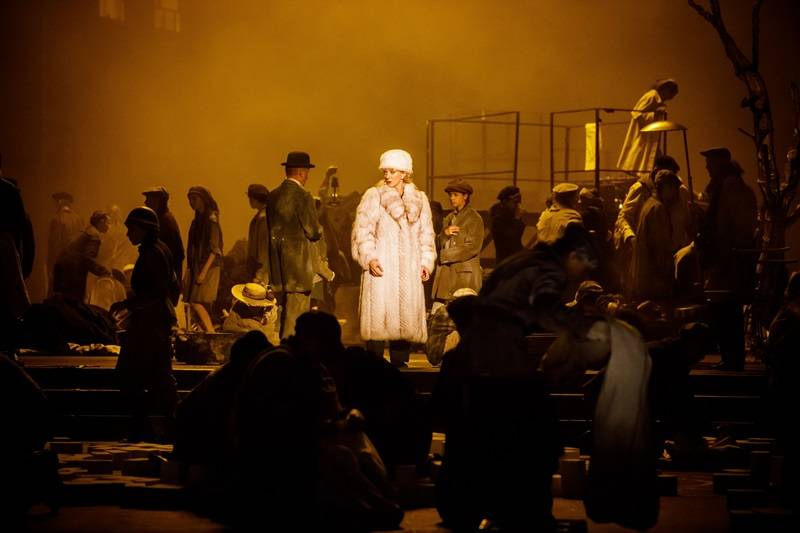
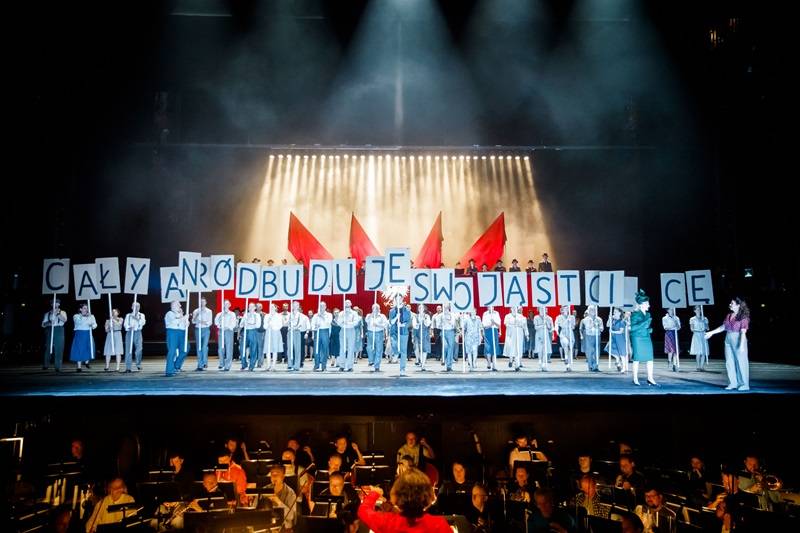
In the choral scenes depicting the reconstruction efforts, where people of all generations of Warsaw join in with enthusiasm (adult and children's choruses of the Polish National Opera), Duchnowski uses a wide range of textures—from lyrical polyphony to declamation and whispering—to showcase the expressive potential of choral music and emphasize the choir’s role.
The voices of yet another main character—the people of Warsaw—comment on the action and express their emotions.
Thanks to Duchnowski’s exceptional electroacoustic score and the opera’s large-scale cast, the audience is immersed in an artistic parallel reality. The composer wanted the entire theater to “resound”—using all available acoustic potential, even speakers not normally used for music. The brass section of the orchestra is used to great effect, enhancing the power of the sound. Under the baton of Bassem Akiki, Sinfonia Varsovia masterfully performed not only the powerful passages but also more impressionistic scenes—such as the ghostly visions of the ghetto, or the scene in an orphanage, where a wounded child, Tereska, draws chaos instead of home.
At the beginning of the opera, the narrator, actor Filip Kosior, states that Warsaw is a city that rose from death. In the final moments of the work, we see a glimmer of light—a partial breakthrough of sunlight. Even during the terrible 1940s, when Warsaw’s post-uprising resurrection coincided with the loss of Poland’s independence, exceptional dreamers were trying to build the best city in the world.
Humanity may fail to learn from history, but history does contain a trace of immortality—by telling stories of remarkable individuals to new generations, we momentarily bring them back to life…
Good news for those who couldn’t get tickets:
A recording of the opera will be available for streaming starting in December on vod.teatrwielki.pl
Co-producers: Grand Theatre – Polish National Opera, Sinfonia Varsovia
Partner: Warsaw Autumn International Festival of Contemporary Music
Funding: City of Warsaw, Ministry of Culture and National Heritage
Premiere Sponsor of Grand Theatre – Polish National Opera: ORLEN
Media patronage: Polish Music Information Centre POLMIC
Project website: https://operaowarszawie.teatrwielki.pl/
Photos by Krzysztof Bieliński (courtesy of the Teatr Wielki – Polish National Opera)

Galeria